
Top Signs You Need Garage Door Service – Don’t Ignore These
A garage door usually tells you it’s failing long before it stops moving. Grinding, a door that opens slower than it did last year, a small gap at one corner, a pop you hear once and forget – these are mechanical warnings with a countdown attached. Most complete garage door failures are preceded by weeks of ignored symptoms, and nearly every one of those early warnings is a cheaper fix than the breakdown it leads to. Here’s how to read the signals before they become a dead door. If you’d rather not diagnose it yourself, call (833) 468-3082.
Key Takeaways
- Noise is information – each sound points to a specific component under stress.
- Slow operation is almost never the opener motor; it’s friction or a balance problem.
- A 30-second balance test can reveal weakening springs before they snap.
- Intermittent failures are more urgent than consistent ones, not less.
- Most early fixes cost far less than the full failure they prevent.
What Do the Five Warning Sounds Actually Mean?
Every noise a garage door makes translates to a specific part under load. Learning the vocabulary turns a vague “it sounds bad” into a diagnosis you can act on. Here’s what we listen for when a door comes in for garage door repair in Irvington.
- Grinding: Metal-on-metal contact, usually worn rollers or dry, failing bearings. Left alone, grinding chews through the track and turns a roller swap into a track replacement.
- Squealing: A high-pitched squeal points to torsion springs or hinges that have lost lubrication. It’s the cheapest sound to fix early and the most expensive to ignore.
- Popping: A sharp pop, often when the door first moves, usually means a spring is slipping or a cable has jumped its drum. This is the sound that deserves a call, not a wait-and-see.
- Rattling: Loose hardware – hinges, brackets, bolts that have worked free from vibration. Rattling is cosmetic at first and structural later.
- Clicking: Often the opener’s gear or logic board, or a photo-eye misalignment. A clicking opener that doesn’t move the door is a control problem, not a door problem.
Any single sound on this list is worth a look. Two together, especially grinding plus popping, means the system is already under strain. In our experience across Irvington homes, the grinding-and-squealing combination is the one homeowners most often dismiss as “just an old door,” and it’s the one that most often precedes a snapped spring.
What Visual Signs Do Homeowners Walk Past Every Day?
You pass your garage door every morning, which is exactly why you stop seeing it. These visual tells are the ones that matter, and most of them are visible from the driveway in under a minute.
- Misaligned tracks: A track that’s bent or pulled away from the frame forces the door to fight its own path. A door that runs on a crooked track wears out rollers and springs fast.
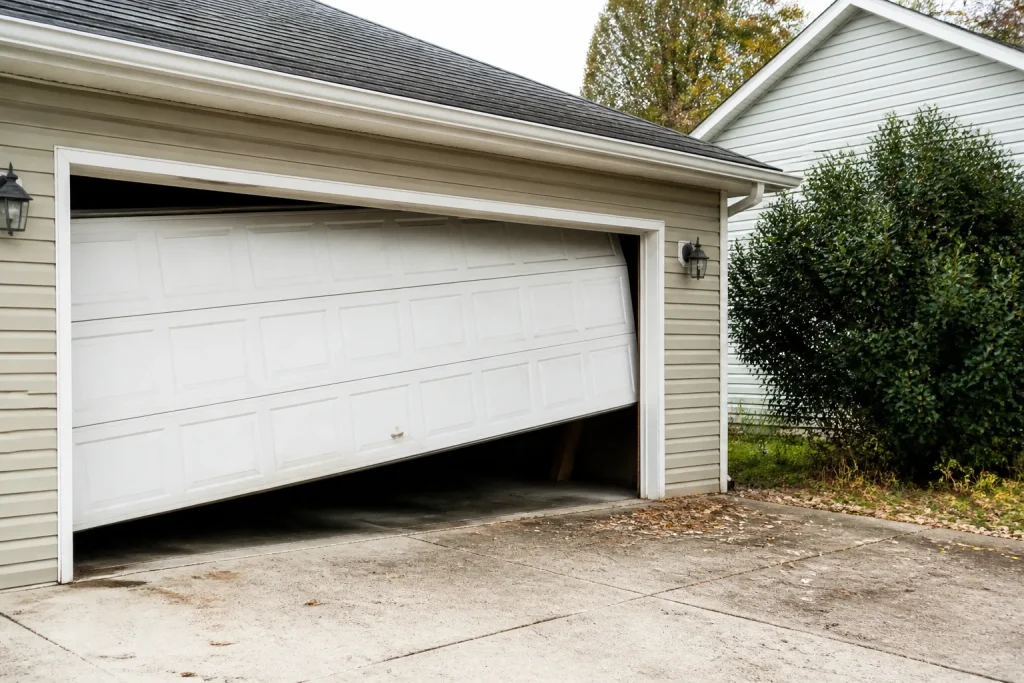
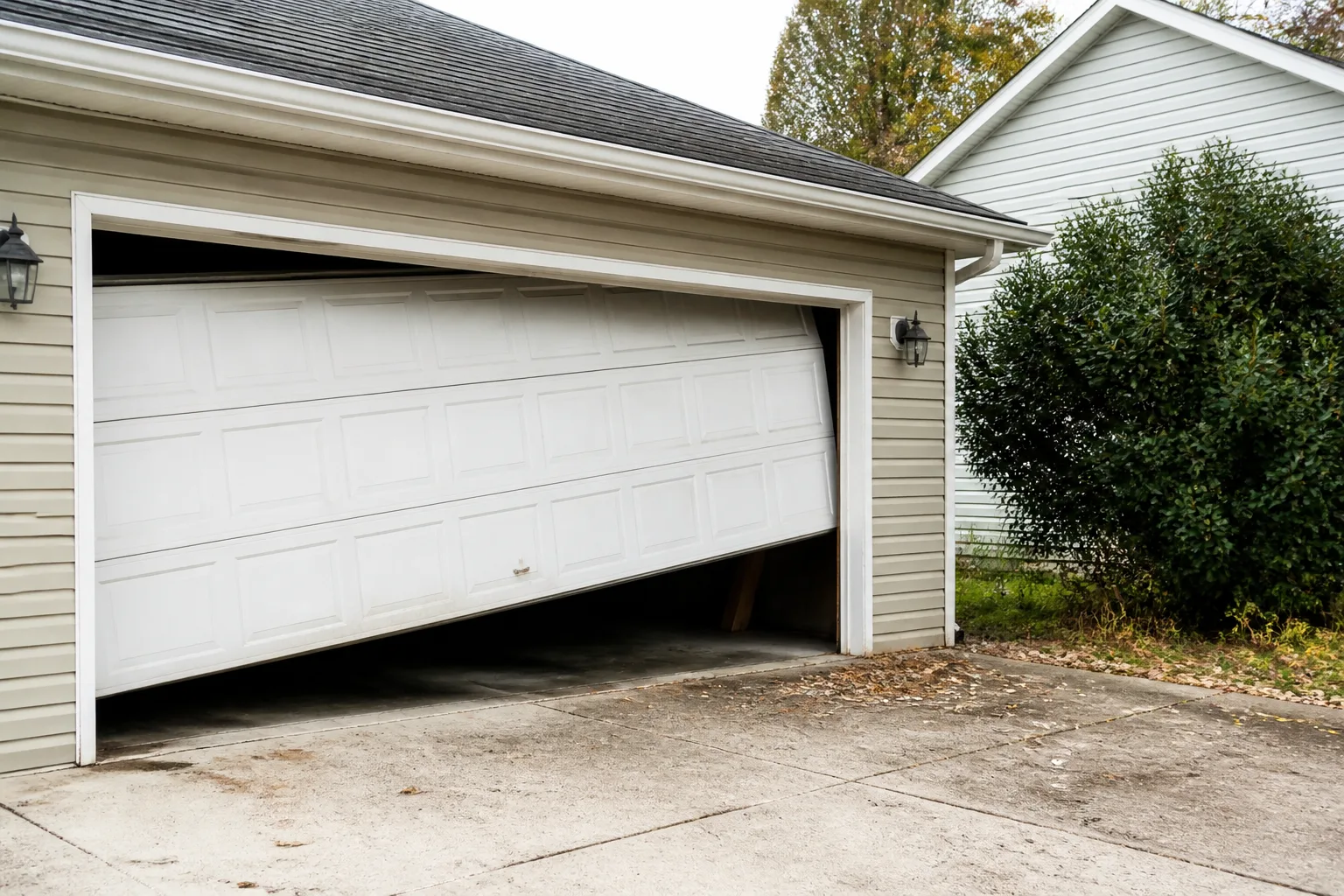
- Uneven gaps: If one side of the closed door sits higher than the other, the door is out of balance or a cable has stretched. That gap also lets weather and pests in.
- Rust patterns: Surface rust on the bottom panel is cosmetic. Rust clustered around hinges, springs, or cable ends means moisture is attacking moving parts – the spots where failure starts.
- Frayed cable edges: A cable with broken strands near the drum is a cable about to fail. Frayed edges are a stop-using-the-door sign, not a schedule-it-next-month sign.
Walk out to your Irvington driveway and check these four things right now. If the track looks straight, the gap is even, and the cables are clean, you’re in good shape. If any one of them looks off, that’s a door asking for service before it becomes a door that won’t open at all.
Why Is My Garage Door Suddenly Opening So Slowly?
This is the most misdiagnosed symptom we see. A door that’s gotten sluggish is almost never a failing opener motor – it’s friction or a balance issue in the mechanical system. The motor is just working harder against resistance it shouldn’t be fighting, and eventually that motor loses.
Here’s the logic. The opener is designed to lift a properly balanced door with modest effort. When springs lose tension, rollers dry out, or a track drifts out of alignment, the door gets heavier to move or drags against its path. The opener compensates by drawing more current and running longer. That extra strain shows up as a slow, labored cycle. Over weeks it wears the opener’s gears and overheats the motor.
So when a Chamberlain or Genie opener starts to feel slow, the instinct is to blame the opener. More often the fix is in the door’s balance and hardware, and the opener is the victim, not the cause. We check the whole mechanical picture rather than swapping a motor that was never the problem. If the door also hesitates or reverses partway, that points to a safety-sensor or force-setting issue on top of the friction – worth a proper look rather than a guess. Our garage door opener repair work starts with the door, not the box on the ceiling.
How Do You Run the 30-Second Balance Test?
This is a check most homeowners have never done, and it reveals whether your springs are losing tension before they snap. A garage door’s springs are the most dangerous component in the system – high tension, stored energy, and no room for error. So this test is a hands-off check, done with the door, not on the springs.
- With the door fully closed, pull the manual release cord to disconnect the opener. The door is now on its springs alone.
- Lift the door by hand to about halfway and let go. Do not force anything.
- Watch what happens. A healthy door stays put at the halfway point. It should neither fall nor rise on its own.
- If it drops, the springs have lost tension. If it drifts up, they’re over-tensioned or the door’s weight is off.
- Reconnect the opener and don’t run the door again until it’s looked at if it failed the test.
That’s the whole check. It won’t tell you how much tension is left, but it tells you whether the balance is right, and balance is what keeps the springs from doing all the work alone. If the door sags or drops, stop here. Don’t attempt to adjust the springs yourself – the tension in a torsion spring can cause serious injury, and this is work for a trained technician. Our Irvington Garage Door Repair Pros team treats spring service as its own discipline for exactly that reason.
Why Are Intermittent Problems More Urgent Than Constant Ones?
A door that fails every single time is a clear, predictable problem. A door that works fine most days and occasionally sticks, reverses, or hesitates is actually the more urgent case – because a consistent problem has already declared itself, while an intermittent one is a warning you’re still being given.
Intermittent behavior usually comes from one of a few causes: a loose connection or worn contact that only breaks under certain loads, a track that’s just slightly out of line and only catches at a certain temperature or angle, a safety sensor that’s marginally misaligned and only trips under low light, or a spring that’s just at the edge of its tension and only fails to lift the door when it’s coldest. These are the failures that choose the moment you’re leaving for an appointment to stop working entirely.
When a door works “most days,” the wear that causes it is still advancing. The loose part keeps loosening; the marginal sensor keeps drifting. In our experience, the one-time pop or occasional stall almost always turns into a full failure if left alone. If your door has failed even twice in a month, treat it as a live warning rather than a quirk. It’s also worth knowing which brand you’re running – a smart-home LiftMaster or Chamberlain system can often log the fault for you, which shortens the diagnostic.
When Should You Call a Pro Instead of Waiting?
Call a pro the moment any of these show up: a frayed or broken cable, a door that failed the balance test, a popping sound at the springs, a door that won’t stay down or reverses on its own, or two or more warning signs at once. All of those are signs of a component under tension that can fail suddenly. Frayed cables and failing springs are genuinely dangerous – the standard advice is don’t run the door and don’t touch the springs. For a technician, that’s a same-visit repair. For a homeowner, it’s the moment to stop.
One call covers the repair, the parts, and the diagnostics, because the components are part of the service rather than an afterthought. We work on the brand you already have – LiftMaster, Chamberlain, Genie, Clopay, Amarr, Wayne Dalton, Craftsman, and Raynor – so you’re not turned away because of what’s in your garage. Our technicians have up to 15 years of experience.
Related services in Irvington: beyond repair and opener diagnostics, we handle garage door installation for homeowners whose door has reached the end of its mechanical life rather than the start of a repair.
The Bottom Line
The early warnings are cheap to fix and easy to dismiss. A grinding roller, a slow cycle, a small gap, a single pop – each one is the door telling you which part is under strain, and most complete failures arrive only after weeks of those warnings were ignored. If you’ve spotted any of them on your Irvington door, it’s worth a look now rather than a replacement later.
If you’re in Irvington and need help, Irvington Garage Door Repair Pros offers free estimates – call (833) 468-3082. We answer 24/7. Fast dispatch from 7am to 7pm, Sunday through Friday. The price is quoted and agreed before any work starts.
Frequently Asked Questions
Usually a popping sound, followed by the door becoming hard to lift or failing the halfway balance test. If the door drops when released at halfway, the spring has lost tension and should be checked before it snaps. The springs are the most dangerous part of the system, so don’t adjust them yourself – call (833) 468-3082.
Not always, but noise is never meaningless. A single squeal or rattle is fine to schedule. Grinding plus popping, or any noise paired with a door that hesitates, is worth a prompt call because it signals components already under strain. Call (833) 468-3082 for a free estimate.
Intermittent failures come from a marginal part – a slightly loose connection, a track just out of line, or a spring near the edge of its tension. They’re more urgent than constant failures because the wear is still advancing while the door mostly works. Book a diagnostic before it fails completely.
Yes. A door with friction or balance issues makes the opener work harder, drawing more current and running longer, which wears its gears over time. The fix is usually in the door’s balance and hardware rather than the motor. Call (833) 468-3082 for an exact quote – estimates are free.
Written by the team at Irvington Garage Door Repair Pros.
Need Garage Door Help?
Call Irvington Garage Door Repair Pros - the local pro we connect you with is licensed and insured, here with fast help in Irvington.
(833) 468-3082