
Garage Door Repair: Repair or Replace? How Irvington Homeowners Decide
A company that only sells new doors will always find a reason your twelve-year-old door needs to go. A company that only repairs will keep patching a door that’s genuinely finished. Neither is lying to you, exactly. They’re just answering from inside their own business model. The way out is to understand the five structural factors that actually decide this: panel integrity, spring system condition, track and hardware wear, opener compatibility, and insulation performance. Score those honestly and the repair-or-replace question usually answers itself. If you’d rather have a trained eye look at it, call (833) 468-3082 and we’ll give you a straight read.
What’s the short answer on repair vs. replace?
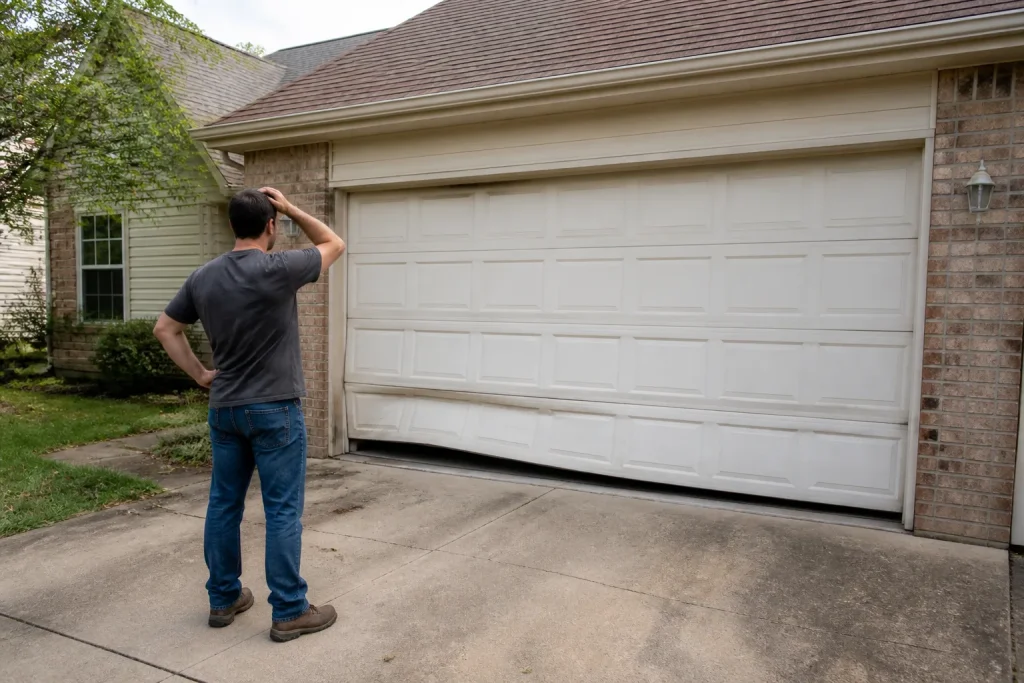
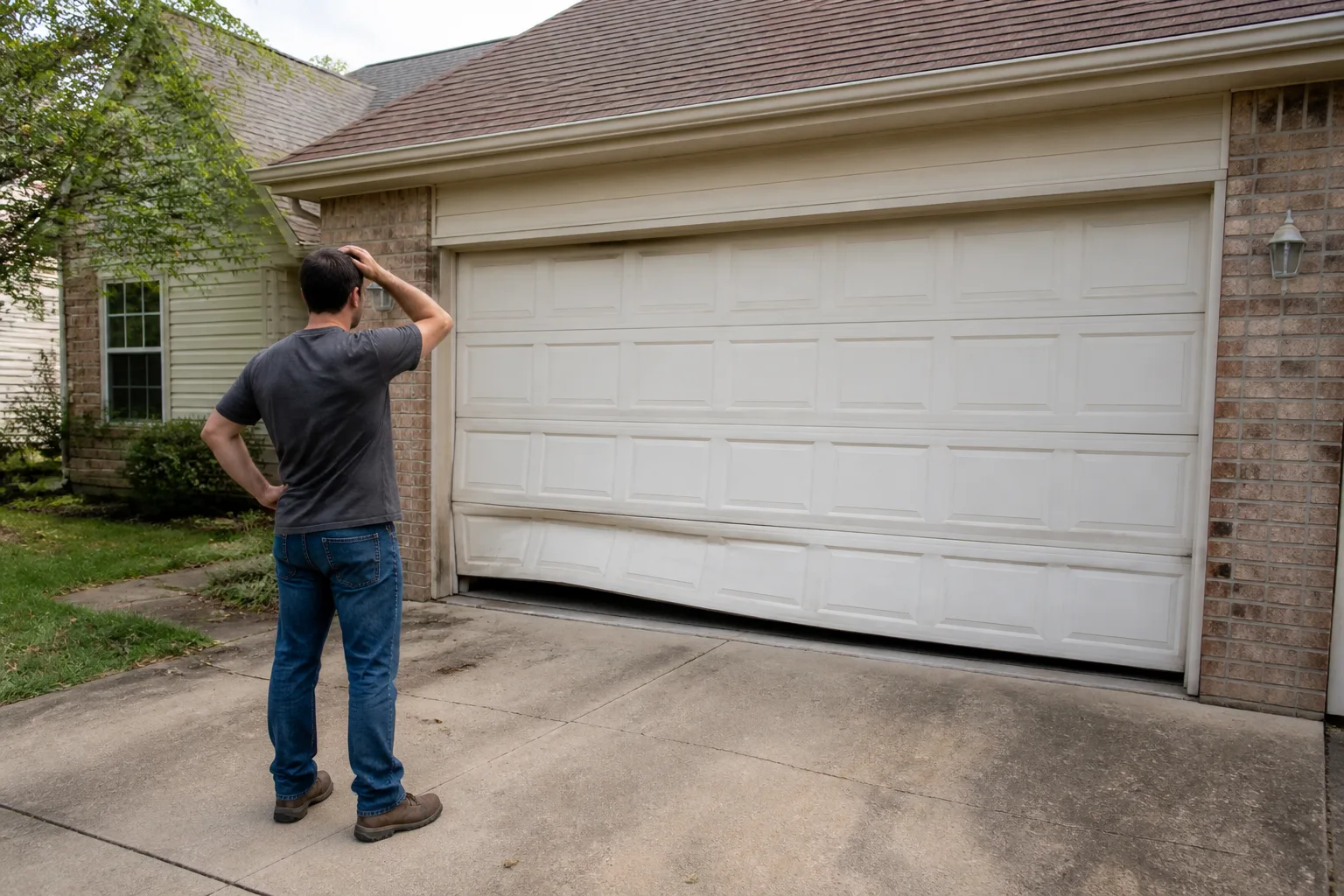
Repair is almost always the right call when the door’s structure is sound and the failure is mechanical. Springs, cables, rollers, hinges, and openers are wear items. They’re supposed to fail eventually, and replacing them restores the door to full function without touching the panels. Replace when the door’s structure itself is compromised: cracked or delaminated panels, a bent track that won’t straighten, or a torsion system so corroded the mounting points are failing.
The mistake we see most often in Irvington is homeowners replacing a door because of a broken spring. A snapped spring looks dramatic, sounds like a gunshot, and leaves the door dead in the tracks. It’s also a repair, and it’s one of the most routine jobs we handle.
Here’s the rough dividing line:
- One failed component, sound panels and track: repair.
- Two or more wear components failing at once on a door with good panels: repair, and budget for a full hardware refresh.
- Cracked, rotted, or delaminated panels on two or more sections: replace.
- Track bent beyond realignment, or hinges pulling free of the panel skin: replace.
- Opener more than a few generations old and no longer supported by the manufacturer: opener replacement, not door replacement.
Notice what’s not on that list: the door’s age. A well-maintained steel door can run decades. A neglected one can be structural trouble at ten years. Age tells you where to look, not what to decide. Our technicians have up to 15 years of experience reading exactly these signals, and experience mostly teaches you to slow down before calling for a new door.
The five-factor framework: how to score your own door
Work through each factor honestly. You don’t need a clipboard, but writing it down keeps you from talking yourself into either answer.
1. Panel integrity
Look at each section from the inside. Hairline cracks radiating from the hinge points are normal stress, not a death sentence. What matters is delamination (the steel skin separating from the core), rust-through, and any crack that runs more than a few inches. One compromised panel on a multi-panel door can usually be replaced individually if the manufacturer still makes that model. More on that below.
2. Spring system condition
The springs carry the whole weight of the door. A single broken torsion spring means the door is now roughly the weight of a small refrigerator, held by a thin cable. This is the component that traps the most untrained homeowners, and springs are the most dangerous part of the system. We treat them that way. Check for the obvious: is the door fighting you when you lift it by hand (springs losing tension), or is it dropping fast (springs over-tensioned or cable failure)? Either answer means a professional visit.
3. Track and hardware wear
Nylon rollers wear flat. Hinges develop play. The track develops dents, and a bent track drags the door and eats everything else. Straightforward to replace and generally worth doing on a sound door.
4. Opener compatibility
If you have a newer Chamberlain or Genie unit in good repair, the opener isn’t part of the decision. If you have a legacy Craftsman or Genie system with a cracked logic board, the door itself might be fine while the opener is a genuine replacement candidate. Those are two separate decisions and shouldn’t be bundled into one sales pitch.
5. Insulation and energy performance
An uninsulated door on an attached garage saps heat in winter. If the panels are otherwise sound, this factor alone rarely justifies a full replacement. If the panels are already failing, though, an insulated replacement improves the same space at the same time.
The math model: where the break-even actually sits
The simple version: add up what you’d spend on repairs over the next few years, and compare it against the cost of a new door installed. That’s not quite how it works, though. A properly repaired door resets the clock on that component. A door with a new spring system, new rollers, and new hinges is functionally a young door, even if the panels are twelve years old. What you’re really buying with a repair is a service life extension on that component.
The practical question is whether the door has one big repair ahead or a rolling series of small ones. One big repair on a door with structurally sound panels almost always wins the math. Three repairs in eighteen months on a door already showing panel fatigue usually doesn’t. Our garage door repair team can give you a written estimate, so the comparison is against a real number, not a guess.
We won’t pretend the “keep repairing” path is always smarter. It isn’t. A door with a bent track and cracked panels is a money pit, and no honest diagnosis pretends otherwise. But a door that needs springs today and hinges next year isn’t the same thing.
When brand discontinuation forces the decision
Sometimes the manufacturer makes the call for you. Clopay, Amarr, and Wayne Dalton all rotate their residential door models, and replacement panels for discontinued models can be hard or impossible to source. When that happens, a single damaged panel can’t be matched exactly. You’re left with options that are all compromises: patch the panel with a close-color substitute that doesn’t quite line up, replace the whole door, or live with the damage. This is the single clearest case where a sound technical decision to repair becomes impractical because of parts availability.
The good news: we supply garage door parts as a standing part of our work, not an afterthought. We can usually tell you within a conversation whether your model’s components are still manufactured. We work on Chamberlain, Genie, Clopay, Amarr, and several other major brands, so whatever is in your garage is likely in our scope. If the part exists, the repair usually proceeds. If it doesn’t, you’ll know why, not just that.
Why Irvington’s housing stock complicates replacement
Older homes are a genuine feature of this town, and they come with garage rough openings that weren’t poured to today’s standard dimensions. Replacement is measured, ordered, and scheduled. A standard opening means a standard door, off the order book. A non-standard opening means custom sizing, framing adjustments, or both, and that adds cost and time compared with a replacement in a newer subdivision.
Which changes the math in a useful direction: on a non-standard opening, a repair on a structurally sound door becomes the clear winner more often than the national averages would suggest. Replacement has a higher floor here than most homeowners assume. Our garage door installation service starts with a proper measure for exactly this reason. A replacement price you were quoted over the phone, without that measurement, isn’t a price.
There’s also the closing mechanism to consider. If your garage door opener is failing at the same time as the door, replacing both together can make sense. But replacing an opener is a separate, often cheaper job that we handle through garage door opener repair.
Red flags in a replacement pitch
Listen for the language that signals an upsell on a door with repair life left.
- “Springs always fail in pairs, so you might as well replace the whole door.” Springs failing in pairs is a real thing, but it means two springs, not two doors.
- A price given before the tech even looks at the door. A real replacement estimate needs a measurement first.
- “Your door is twelve years old, that’s about time.” Age is not a diagnosis. Ask for the specific structural failure.
- Pressure to decide today. A structural failure is real on Monday morning too.
- No offer to repair at all. A replacement-only provider has a conflict of interest on this decision.
A legitimate recommendation names a fault you can see: a cracked panel section, a bent track, a hinge that’s pulling through the door skin. If the tech can’t put a finger on it, the recommendation doesn’t hold up.
When to call a pro
Springs are not a project for a homeowner with a ladder and good intentions. The stored tension in a torsion spring is enough to break arms and worse, and the cable system has to be reloaded under that tension. We handle the diagnosis and the repair. For the routine checks, we tell homeowners how a typical job runs and let the trained technicians do the dangerous part.
The opposite mistake is real too: patching a door that’s already structurally finished. If you’ve had two repairs in a year on a door showing panel delamination, you’ll get a straight “this one’s done” from us, not a third patch. We’d rather tell you to replace than keep your wallet open.
For the fuller picture of what we do, Irvington Garage Door Repair Pros covers everything from emergency repair and opener diagnostics through spring work, parts, and full installation under one company. One call covers the repair, the parts, and the installation if it comes to that.
The Bottom Line
Repair is the answer when one or two wear components have failed on a door whose panels and track are still sound. Replace when the door’s structure is compromised, when discontinuation has left no parts path, or when a non-standard rough opening makes a replacement quote climb higher than the repair math allows. Score the five factors, then let the estimate set the decision.
If you’re in Irvington and need help, Irvington Garage Door Repair Pros offers free estimates. Call (833) 468-3082. We answer 24/7, and fast dispatch runs from 7am to 7pm, Sunday through Friday. The price is written into the estimate before any work starts, so the invoice matches the number you agreed to. Never the surprise. That’s the whole point of the written estimate.
Frequently Asked Questions
No. A broken spring is a repair, not a replacement trigger, as long as the panels and track are sound. A spring carries the weight of the door and is designed to be serviced or replaced. Keep the door closed and call us. Springs are the most dangerous component in the system, so treat this as a professional job.
Often, yes, if the manufacturer still makes that panel or a matching replacement. Panel replacement is far cheaper than a full door and preserves the rest of a sound door. The catch is brand discontinuation: Clopay, Amarr, and Wayne Dalton rotate models, so a panel from a discontinued line may not be sourceable in the right finish. We’ll tell you honestly which case you’re in.
Probably not. An opener failure is separate from the door’s structural condition. We repair LiftMaster, Chamberlain, Genie, Craftsman, and other major systems, and replacing just the opener is a normal fix. You don’t need a door because the opener quit.
A well-maintained steel door can last decades; a neglected one fails younger. Age, on its own, is not a reason to replace. It tells you what to inspect. Look for panel delamination, rust-through, bent track, or a spring system that won’t hold tension. If those aren’t present, a repair can reset your door’s service life and keep the original doing its job. Call (833) 468-3082 if you want an honest assessment on your door before deciding.
Written by the team at Irvington Garage Door Repair Pros.
Need Garage Door Help?
Call Irvington Garage Door Repair Pros - the local pro we connect you with is licensed and insured, here with fast help in Irvington.
(833) 468-3082